Who Governs the Bridge? The Geopolitics of Cross-Border QR Payments
National QR and instant-payment systems are crossing borders. The strategic question is no longer only who owns the rail, but who sets the terms of connection.
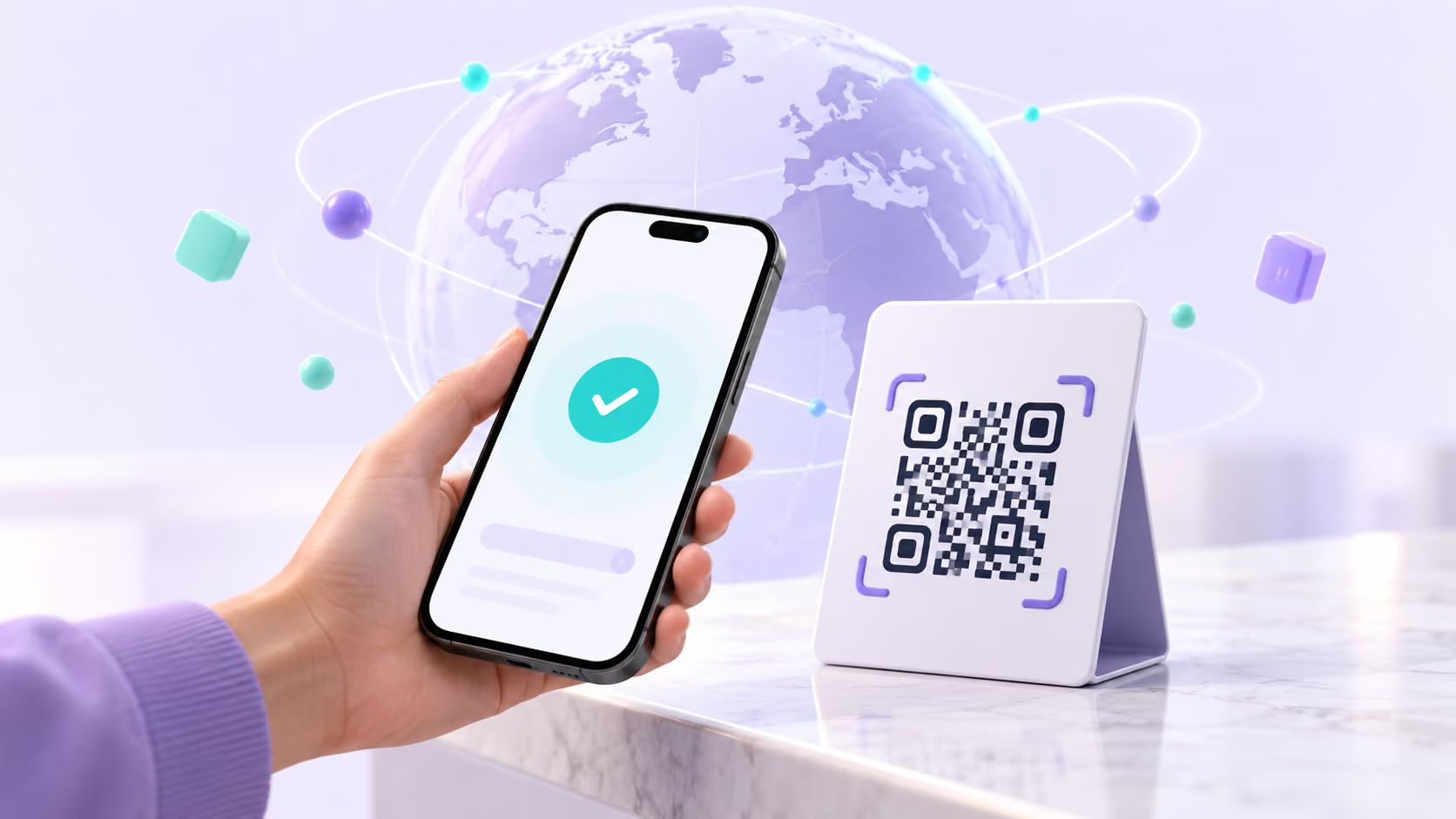
A cross-border QR payment lasts seconds. The negotiations behind it can shape infrastructure for years.
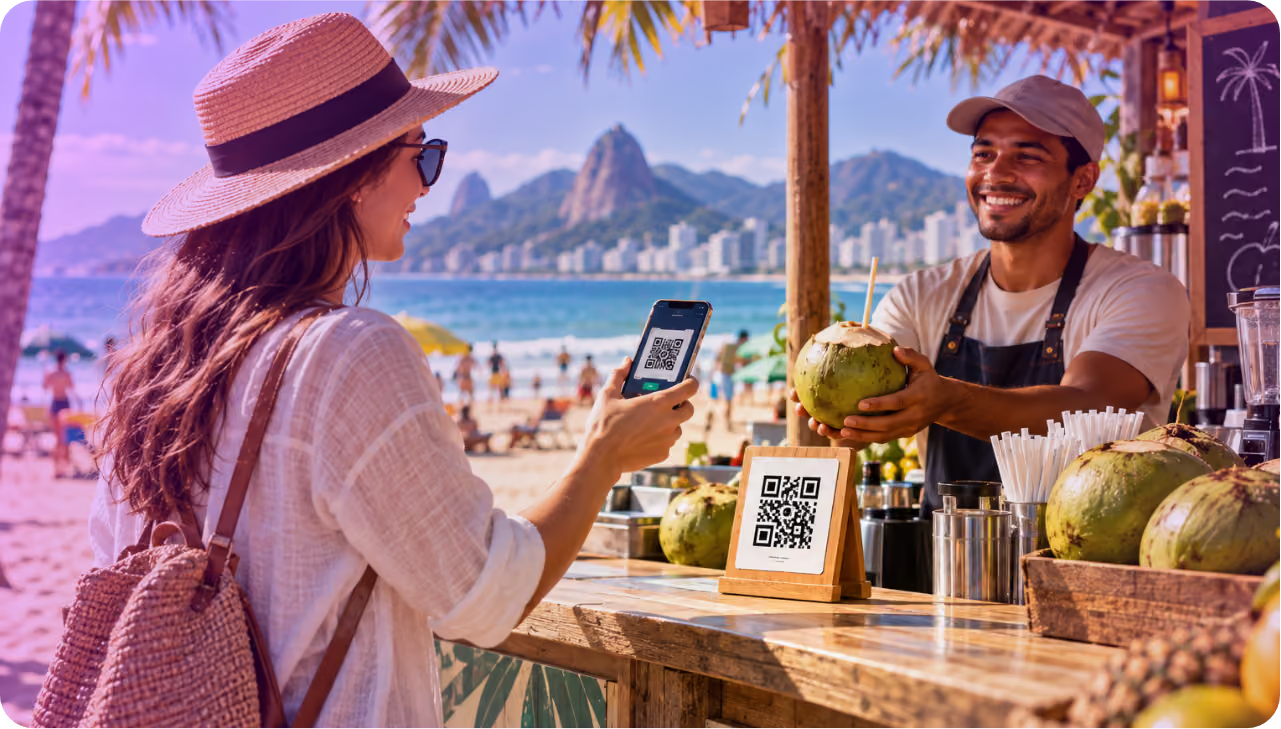
A traveller scans a QR code abroad. A familiar banking app opens. The merchant receives local currency.
The payment looks simple because the agreements behind it remain invisible: identity, compliance, data, FX, settlement, consumer protection, and accountability have already been negotiated before the scan can succeed.
In my previous article, “How Remittance Corridors Become B2B Payment Infrastructure,” I argued that a corridor is an ecosystem of permission and that culture is pre-transaction infrastructure.
That article followed five corridors across the old Silk Road. This one steps back to examine the geopolitical map forming around them.
The world is not only making payments faster. It is renegotiating the terms on which financial systems connect—and discovering that connectivity without cultural permission is an empty corridor.
Efficiency is the public explanation
Ask why countries are modernising payments and the official answers are familiar: speed, cost, transparency, competition, and inclusion.
They are good answers. They are no longer sufficient.
An IMF working paper estimated that traditional and crypto cross-border payments together approached USD 1 quadrillion in 2024. Yet the Financial Stability Board reported in 2025 that global end users had seen only slight improvement since 2023 and that the G20 roadmap was unlikely to deliver satisfactory global progress on its 2027 timetable.2
If efficiency were the entire objective, governments could rely on the largest global networks and demand better pricing. Instead, they are financing national instant-payment systems, domestic schemes, public digital identity, local QR standards, and regional settlement platforms. Payment infrastructure decides whose rules travel with a transaction, where economic data accumulates, and whether access depends on an institution beyond the country’s control.
The payment lasts seconds. The dependency can last a generation.
2022 made the infrastructure visible
In March 2022, the European Union prohibited SWIFT financial-messaging services to seven specified Russian banks as part of its sanctions response to Russia’s invasion of Ukraine.3
The measure was directed at Russia. The lesson travelled much further.
Central banks and finance ministries saw that a payment network could be infrastructure on Monday and leverage on Tuesday. The lesson was not “leave SWIFT.” Its reach, liquidity, standards, and trust remain immensely valuable. The lesson was: never have only one way home.
Resilience is no longer only uptime, cybersecurity, or disaster recovery. It is a portfolio of routes. Countries are not necessarily replacing the old centre; they are reducing the risk of having only one centre.
This is not deglobalisation. It is selective reconnection.
Sovereignty moved down the stack
We used to discuss monetary sovereignty mainly through currency and central banks. Digital payments pushed sovereignty into the machinery beneath them—and beyond payments altogether.
Who verifies the person or business? Who writes the standard? Who stores the data? Who controls the interface and customer relationship? Who provides settlement and FX? Who can join the scheme—and who can be removed?
A country may issue its own currency and still rent much of the infrastructure through which that currency moves. It may own an excellent domestic payment system that becomes irrelevant the moment a citizen or business crosses a border.
Digital sovereignty is the capacity to make meaningful choices over a country’s infrastructure, data, identity, standards, platforms, and economic interfaces. Payments are one expression of it, not its boundary. A country can own the rail and still lose the digital economy above it if foreign platforms control discovery, identity, data, and the customer relationship.
The defining problem is how a sovereign digital ecosystem gains reach without disappearing inside someone else’s network.
Interoperability is the answer—but not the bland, technical version of the word. Interoperability is bargaining power. It allows a country to connect its system without first surrendering the system.
Sovereignty is not the refusal to connect. It is the ability to negotiate the connection.
The API can be live while the market is absent
I see this in daily work. A payment method is enabled. The technical team marks the corridor live. The announcement goes out.
Then very little happens.
The usual diagnosis is adoption. The deeper problem is that access was mistaken for a market.
A payment corridor needs at least five layers. The technical layer moves the instruction. The regulatory layer makes the flow permissible. The commercial layer gives merchants and institutions a reason to participate. The cultural layer makes the proposition legible and trustworthy. The demand layer creates repeated reasons for money to move.
Most launches overinvest in the first two and assume the last three will appear by themselves. They do not.
Localisation is often reduced to translating a checkout page. Real localisation asks which use case should open the corridor, who already has trust, which partnership gives the launch social permission, how price and FX should be explained, who answers when something goes wrong, and what the payment means in that market.
The answer is different for a Chinese traveller in Kazakhstan, an Uzbek worker in South Korea, an Armenian merchant trading with India, or an African airline trying to release capital trapped across currencies.
The rail does not create those relationships. It enters them.
This is why marketing has changed. In a mature domestic market, marketing can describe a product. In an emerging cross-border corridor, marketing helps assemble the market around it.
It identifies the first community with a reason to move, recruits institutions that already hold trust, and turns a foreign capability into a locally intelligible behaviour. Marketing is not applied after infrastructure. In a new corridor, it is part of the infrastructure.
The API creates access. Localisation creates permission. Repeated use creates the corridor.
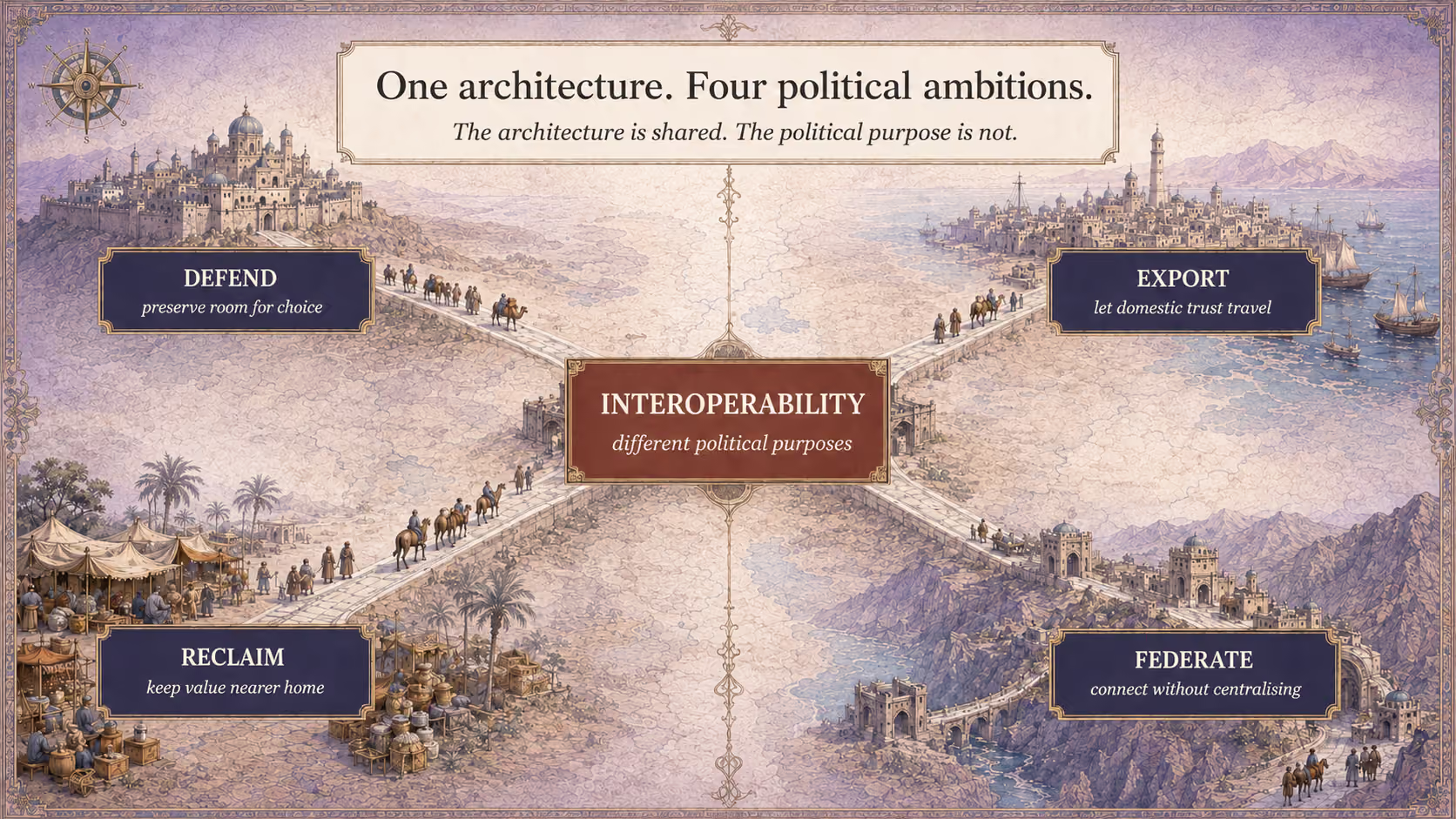
The same architecture, different political verbs
Europe is defending. Its March 2026 payments strategy explicitly links innovation with a more robust and autonomous European system, the role of central-bank money, and the international position of the euro. That sits inside a wider sovereignty agenda spanning semiconductors, AI, cloud, open source, and digital identity.45
India is exporting. By June 2026, UPI had 554.9 million users and processed 241.6 billion transactions in the 2025–26 financial year; official data listed live links across ten overseas markets. This is not a wallet travelling. It is an architecture becoming foreign economic policy.6
Southeast Asia is federating. More than 70 countries now operate domestic instant-payment systems. In 2025, the central banks of India, Indonesia, Malaysia, the Philippines, Singapore, and Thailand incorporated Nexus Global Payments to take a standardised connection model into live implementation. The sovereign systems remain. A shared institution governs the bridge.7
Africa is reclaiming. PAPSS reported real-time cross-border payments across 17 countries, 14 national switches, and more than 150 commercial banks. Its African Currency Marketplace addresses another dependency: the estimated USD 5 billion lost each year because intra-African trade must often pass through an external hard currency.8
The Arab region is bridging. Buna, supported by Arab central banks and fully owned by the Arab Monetary Fund, provides a multi-currency system while allowing each eligible currency to retain its own independently pre-funded circuit.9
Brazil is proving. More than 170 million individuals—about 80% of the population—have used Pix, and the system processes billions of transactions in a single month. Once a domestic rail reaches that scale, cross-border reach becomes a strategic question.10
Different continents. Different motives. The same architecture.
Build the endpoint. Standardise the connection. Govern the bridge.
Every connection chooses a world
A bilateral QR link is easy to describe as an integration. That word is too small.
The link chooses which institutions may face one another. It aligns compliance expectations, routes data and liquidity, determines the settlement currency, and establishes who owns the exception when a payment fails. The go-to-market chooses whose trust introduces it to the public.
In other words, it encodes recognition.
These choices will follow trade, tourism, migration, supply chains, and diplomacy. Some will reveal asymmetry: one country’s wallet travels while the other’s does not; one currency settles while another is merely converted; one scheme keeps the customer while another becomes invisible.
Calling all of this “interoperability” can hide the distribution of power inside the connection.
The question is not only whether two rails connect. It is who sets the terms of translation.
The bridge is the next strategic asset
Here is where I will plant a flag.
The next contest in payments is not only over who owns the rail. It is over who governs the bridge between rails.
Technical translation is the easy part. The bridge must translate identity, compliance, currency, settlement, transaction limits, data, consumer protection, language, expectation, and accountability without flattening the rules and culture that make each endpoint sovereign.
This is not neutral middleware. It is an operating institution at the border between jurisdictions. Its credibility is built in the operational work: routing and processing, FX and settlement, reporting, fraud controls, customer support, and exception recovery.
From where I sit, bringing connections to market across Central Asia, Southeast Asia, and other emerging markets, countries are not asking for another global logo. They are asking how the system people trust at home can work abroad without being absorbed by a foreign one—and how the corridor will create local participation rather than merely foreign access.
Smaller and emerging markets feel concentration risk first. An FSB-commissioned survey found that almost half of the emerging and developing economies surveyed had experienced a decline in correspondent-banking services, with Eastern Europe and Central Asia among the particularly affected regions. Migration, sanctions spillovers, currency constraints, and trade realignment are not conference themes there; they are operating conditions.11
Central Asia was not an exception in the previous article. It was the preview.
AI will read the treaty
AI has a decisive role here, but it is not the protagonist.
An agent choosing how to pay across borders needs to know which rail can carry the transaction, under which authority, at what cost, with what settlement certainty, and with which proof of permission.
The machine will encounter sovereignty as rules: accessible or prohibited, verified or rejected, routable or blocked.
Local rails execute. Intelligence chooses. Governance permits.
As the payment world becomes more plural, the ability to translate reliably between systems becomes more valuable.
The map is being redrawn in permissions
The industry keeps asking which currency, wallet, stablecoin, or network will win. That question still assumes the future needs one centre.
It may not.
No currency needs to dethrone the dollar for the infrastructure beneath global commerce to diversify. The dollar still held the largest share of global cross-border payment value in the IMF’s 2021–24 data; diversification beneath that level is the quieter change. No domestic scheme needs to defeat cards to gain strategic importance. No universal rail needs to replace every national system.12
The geopolitical change is the multiplication of credible options.
Countries want reach without dependence, resilience without isolation, and participation without accepting that every rule, interface, data model, or market narrative must be written elsewhere.
The old map of financial power was drawn mainly in currencies and correspondent relationships.
The next one will also be drawn in permissions.
Who may connect. Which identity is recognised. Whose rules survive the crossing. Whose culture shapes the experience. Who owns the customer relationship. Who can switch the route off.
Every QR code looks local, but the arrangement behind it is global.
You may be interested in:
.avif)
Continue Your Research
Explore More 8B Research
Discover how history, culture, migration and financial infrastructure shape cross-border payment corridors.
How Remittance Corridors Become B2B Payment Infrastructure
Explore how trusted remittance routes can evolve into broader B2B payment infrastructure, and why technology alone is not enough to build a working corridor.