How Remittance Corridors Become B2B Payment Infrastructure
Remittance corridors solve identity, liquidity and last-mile delivery before they become commercial-payment infrastructure. As these capabilities mature, the same rails can support contractors, merchants, suppliers and B2B payments.
Remittance corridors are usually treated as consumer-payment markets: migrants send money, families receive it and providers compete on speed, price and reach.
But this view captures only the corridor’s first economic purpose.
Before a corridor can carry regular remittance flows, its participants must solve some of the most difficult problems in cross-border payments: identity, liquidity, foreign exchange, bank acceptance, beneficiary reach and last-mile delivery. As these capabilities mature, the same infrastructure can begin supporting contractors, creators, merchants, suppliers and exporters.
The corridor remains. The payment changes category.
This article develops the operational implications of the argument presented by Daria Kashurina, Founding CMO of 8B, in her thought-leadership contribution to The Paypers, “Cross-border payments: AI routes, trust builds the corridor.”
Read the full thought-leadership article in The Paypers →
Remittances build the corridor under pressure
A remittance is rarely an isolated transfer. Repeated flows continuously test whether a corridor can identify senders and recipients, convert currencies, reach local banks or wallets, manage liquidity and recover from failed transactions.
Over time, this pressure creates more than a payment route. It creates operational knowledge:
- which beneficiary details local institutions accept;
- which rails perform reliably for a particular payment purpose;
- where liquidity is required;
- which transliterations and address formats cause failures;
- how exceptions should be resolved;
- and which institutions users already trust.
Migration therefore helps establish infrastructure before the market is described as a commercial-payment opportunity.
Our research into five corridors — Armenia–India, Uzbekistan–South Korea, Azerbaijan–Turkey, Kazakhstan–China and China–Tajikistan — shows that trust can be inherited, cultivated, engineered or divided between different economic directions. In every case, however, it eventually becomes visible through payment behaviour.
The second market inside national payment rails
National QR and account-to-account systems are often presented as consumer checkout products. Their interfaces may be retail, but their economic use is increasingly commercial.
Analysis of Banco Central do Brasil data illustrates the shift. In December 2025, B2B transfers accounted for 49.54% of Pix transaction value. When P2B and B2P payments are included, 73.82% of Pix value involved a business.
Similar infrastructure is developing across Eurasia. Kazakhstan has introduced nationwide interbank QR payments, Turkey’s FAST system processed 5.4 billion transactions in 2025, and Uzbekistan’s unified UzQR acceptance regime took effect in July 2026.
Once these systems establish familiar payment addresses, instant settlement and trusted acceptance standards, they can support more than checkout. They become part of the operating infrastructure of the economy.
What changes when the recipient becomes a business?
A personal remittance and a commercial payment can use the same corridor, liquidity pool or beneficiary network. But they do not represent the same economic activity.
A remittance moves household value. A B2B payment settles a commercial obligation.
When a recipient becomes a contractor, marketplace merchant, supplier or exporter, the infrastructure needs an additional control and data layer:
- KYC must be supplemented by KYB;
- consumer limits must become commercial limits;
- beneficiary details must become verified business identities;
- payment purpose must be supported by invoice and transaction data;
- payment confirmation may require evidence of delivery;
- manual support must become structured exception ownership;
- reconciliation must connect with ERP and treasury systems.
The infrastructure does not need to be rediscovered. It needs to be extended for a new economic purpose.
AI makes corridor knowledge operational
AI can help convert accumulated corridor knowledge into routing decisions.
Its role is broader than customer support. AI can structure payment data, reconcile transliterations, classify transaction purpose, predict liquidity requirements and identify recurring failure patterns.
As cross-border payment data becomes more structured and Swift phases out unstructured postal addresses from CBPR+ payment messages in November 2026, competitive advantage shifts from basic geographic coverage to the ability to understand and orchestrate local data.
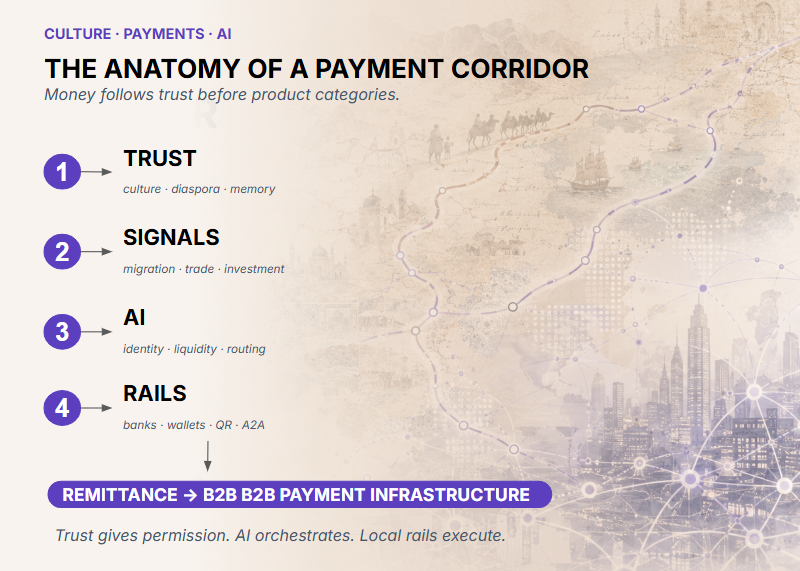
This creates a three-layer model:
- Local rails execute the payment.
- AI selects, structures and orchestrates the route.
- Trust determines whether the participants accept it.
AI can make trust signals legible and routable. It cannot create the institutional history, user confidence or accountability on which a corridor depends.
A second commercial life, not a pivot
The evolution from remittances to commercial payments should not be understood as a provider abandoning one market for another.
It is a second commercial life for infrastructure that already connects banks, wallets, local payment systems, liquidity and beneficiary networks.
A corridor may begin with family transfers, move into contractor payouts and merchant settlements, and eventually support B2B workflows, ERP-based reconciliation and other regulated forms of cross-border settlement.
The economic purpose changes before the corridor itself does.
For payment providers, banks and fintech companies, the opportunity is therefore not necessarily to own every rail. It is to understand which rail, under which regulatory and trust conditions, can support the corridor’s next economic purpose.
The transaction is visible. The more valuable asset is knowing what the corridor is ready to become.
You may be interested in: