3.2 Cards per Adult: Inside Uzbekistan’s Expanding Payment Ecosystem
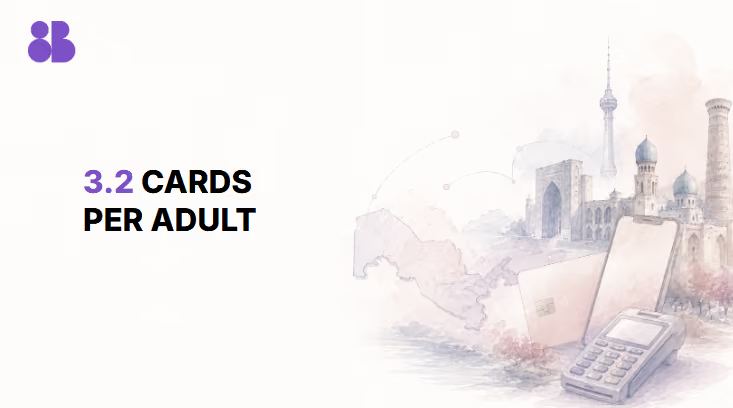
Uzbekistan has built the foundations of a highly connected payment market. Card ownership is widespread, digital banking has become mainstream, and domestic schemes HUMO and UZCARD provide extensive local reach. According to the Central Bank of Uzbekistan’s pilot National Financial Inclusion Indices 2025 report, an average of 3.2 bank cards have been issued per adult. Bank cards are held by 83% of adults, around 77% are active internet-banking users, and 86.3% of the population has access to mobile internet for making payments. These figures point to a market with significant payment scale and a digitally connected customer base. Uzbekistan is now entering its next stage of development: turning this reach and digital readiness into a broader range of everyday merchant payments.
A strong foundation for digital payments
The Central Bank’s new framework measures financial inclusion across access, usage and quality. Payment services are the strongest area for individual access, scoring 69 out of 100. Their quality score is even higher, at 74.
The access score is supported by several indicators:
- 3.2 bank cards issued per adult on average
- 83% of adults holding a bank card
- Around 77% of adults actively using internet banking
- 86.3% of the population having access to mobile internet for payments
Together, these indicators show that Uzbekistan does not need to build digital payment behaviour from scratch. Consumers already hold payment instruments, use banking applications and have the connectivity required to transact remotely.
For merchants and payment providers, this creates an attractive starting point. The customer base is connected, familiar with digital financial services and supported by mature domestic payment infrastructure.
HUMO and UZCARD provide extensive domestic reach
HUMO and UZCARD sit at the centre of Uzbekistan’s local card ecosystem. They support everyday domestic transactions, salary and social-payment programmes, card-to-card transfers, utility and government payments, and integrations with banking and payment applications.
Their importance extends beyond the number of cards issued. Local schemes connect consumers, banks, applications and merchants through infrastructure designed for domestic UZS payments.
For international merchants, accepting HUMO and UZCARD means meeting customers inside the payment environment they already know and use. Familiar local payment methods can reduce friction at checkout and extend acceptance beyond customers who rely primarily on international cards.
International networks remain important for travel, foreign-currency transactions and global acceptance. The practical structure of the market is therefore not “local cards versus international cards.” It is a multi-rail ecosystem in which domestic and international schemes perform complementary roles.
Digital payment behaviour is already established
Person-to-person transfers account for 69% of all payment transactions in Uzbekistan. This high share demonstrates that moving money through digital channels is already an established consumer habit.
The next opportunity is to extend that behaviour into a wider variety of payment situations: e-commerce, marketplaces, digital services, utilities and everyday merchant purchases.
Payment services received a Usage Index score of 34 out of 100. This does not mean that only 34% of people use digital payments; it is a composite indicator measuring how actively, regularly and broadly payment instruments are used. The result highlights substantial headroom for further growth as the market develops beyond its current transfer-led activity.
More than half—53%—of domestic cards were active over the previous 12 months. The remaining issued base represents considerable potential for banks, merchants and payment providers to deepen engagement, increase transaction frequency and introduce more relevant payment use cases.
From card reach to merchant-payment growth
The Central Bank identifies activating existing cards, expanding merchant acquiring and widening everyday digital payments as priorities for the next phase of financial inclusion.
This is a natural progression for a market that has already achieved broad access. Card issuance has created scale. Banking and payment applications have created digital reach. Domestic schemes have created local connectivity. The next layer is to make these capabilities available across more merchant journeys.
For e-commerce businesses, the opportunity is particularly clear. Consumers may be digitally active without using the same payment instruments at every online checkout. Giving them access to familiar domestic methods can help convert digital readiness into completed purchases.
Merchant acquiring should therefore be understood more broadly than the deployment of physical terminals. It also includes local online acceptance, payment initiation through applications, reliable processing, UZS settlement and the operational infrastructure needed to support digital commerce.
A market moving towards multi-rail acceptance
Uzbekistan’s payment ecosystem is becoming more diverse. HUMO and UZCARD provide domestic card reach. Visa and Mastercard support international utility. Co-badged products connect domestic and international functionality. QR and account-to-account payments are adding new ways to initiate payments through banking and payment applications.
Each rail solves a different part of the customer journey. The strongest merchant proposition is not to select one system at the expense of another, but to make the relevant methods available through a consistent checkout and operational experience.
For merchants and payment providers, this requires more than technical acceptance. They also need:
- Local payment routing and processing
- Settlement in UZS and cross-border settlement options
- Foreign-exchange management
- Reconciliation and reporting
- Fraud prevention and operational support
- A single integration across multiple payment methods
As the number of rails grows, orchestration becomes more valuable. Consumers can continue using the local cards and applications they recognise, while merchants manage the complexity through one technical and operational layer.
Why Uzbekistan is attractive for international merchants
The latest Central Bank data brings together several characteristics that make Uzbekistan an increasingly attractive payment market:
- Broad card ownership. With 83% of adults holding a card and 3.2 cards issued per adult, the addressable base is already substantial.
- Strong digital access. Internet banking and mobile connectivity make remote payment journeys available to most adults.
- Established digital habits. The scale of P2P activity shows that consumers are comfortable transacting through digital channels.
- Powerful domestic rails. HUMO and UZCARD connect merchants to payment instruments used across everyday financial life.
- Significant growth headroom. Greater card activity, merchant acceptance and payment-use diversity can expand transaction depth without requiring the market to rebuild its foundations.
The opportunity is no longer limited to bringing consumers into the formal payment system. It is increasingly about serving an already connected population through more relevant local payment experiences.
Source: Central Bank of the Republic of Uzbekistan, National Financial Inclusion Indices 2025 Pilot Report. The report uses official 2025 statistics and aggregated provider data and assesses financial inclusion primarily from the supply side. A demand-side assessment based on consumer and business surveys is planned for a later stage.
You may be interested in: