Armenia–India. The Silk Road's Secret Engine: A Stateless Trade Empire
Armenian merchants from New Julfa created one of the early modern world’s most sophisticated cross-border trade and financial networks. Operating from Isfahan to Surat, Madras, Manila and Acapulco, they moved silk, textiles, precious stones, credit and commercial intelligence across empires without a state, a navy or a formal banking system. Their success offers a striking historical model for today’s cross-border payment infrastructure: trust as collateral, information as capital and interoperability across multiple currencies, jurisdictions and commercial systems.
Long before global banks, payment networks and real-time settlement, Armenian merchants built a commercial network connecting Persia and India with Europe, Southeast Asia and the Pacific.
Operating from New Julfa, an Armenian suburb of Isfahan, they moved silk, precious stones, textiles, credit and information across competing empires. They had no state-backed fleet and no single imperial network behind them. Instead, they relied on trusted agents, commercial agreements, community institutions and an unusually effective system for circulating information.
Their experience offers an early illustration of a principle that still shapes cross-border payments today: infrastructure works only when trust can travel with the transaction.
From forced relocation to a global commercial network
The story of New Julfa began with forced displacement.
In 1604–1605, Shah Abbas I relocated thousands of Armenian families from Old Julfa, a prosperous trading town on the Araxes River, to Isfahan. The original settlement was destroyed, while the displaced community was resettled in a new suburb that became known as New Julfa.
The Safavid Empire depended heavily on silk exports and needed merchants capable of connecting Persian production centres with international buyers. The Armenians of Julfa already possessed commercial experience, multilingual capabilities and relationships that extended across political and religious boundaries.
From New Julfa, their network expanded through the Persian Gulf and the Indian Ocean. Armenian merchants established commercial communities in Surat, Madras and Calcutta, while maintaining connections with Aleppo, Venice, Amsterdam, Manila and other trading centres.
The result was one of the most extensive trans-imperial merchant networks of the early modern period.
India was a network, not a single market
India did not function as one unified commercial destination. It was a system of interconnected ports, inland markets and political jurisdictions.
Surat served as a major gateway between the Persian Gulf and the Indian interior. Armenian merchants operated there alongside the English and Dutch East India companies, connecting maritime trade with centres such as Agra and Delhi.
As British influence expanded, Madras became another important node. Armenian merchants were established there by the mid-17th century and remained commercially active into the 18th. They used the infrastructure created by European trading companies while preserving their own commercial relationships and community structures.
Calcutta later emerged as a major centre for cotton, silk and indigo. Armenian merchants developed a lasting presence there, documented through correspondence, community records and surviving architecture.
These cities played different roles, but they belonged to the same commercial system. Goods, credit and information moved through a network of specialised nodes rather than along one fixed route.
That is also how modern payment corridors develop. A corridor rarely depends on a single provider or payment method. It connects local banks, wallets, payment service providers, liquidity partners, merchants and settlement institutions, each performing a different function.
Trust was the operating infrastructure
The New Julfan network was built around the sedawit, a partnership arrangement used by Armenian merchants.
A senior merchant could provide goods and capital to a travelling agent, who would conduct business in a distant market and return an agreed share of the profits. Many agents were relatives or members of the same commercial community, but family ties alone were not enough. The system depended on written agreements, reputation and the possibility of exclusion from future business.
A merchant who broke an agreement risked losing access to partners across the wider network. Reputation therefore operated as a form of commercial collateral.
Armenian churches and community institutions also supported the network. They preserved records, facilitated communication and reinforced mechanisms of trust and dispute resolution across the diaspora. They did not replace every function of a bank or court, but they gave a geographically dispersed community continuity and accountability.
The network demonstrates that commercial infrastructure is not only physical. Ships, roads and ports made transactions possible, but shared standards and trusted relationships made them repeatable.
Information moved alongside money
Armenian merchants did not control the roads or shipping routes they used. Their advantage came from knowing how to navigate them.
Correspondence carried information about prices, political risks, ship arrivals, available credit and conditions in distant markets. A merchant who understood developments in Isfahan, Surat and Amsterdam could make better decisions than a competitor operating within only one market.
Information was therefore not a supporting service. It was part of the infrastructure itself.
The same is true in modern cross-border payments. Moving funds is only one part of the transaction. Providers must also understand beneficiary requirements, local regulation, payment-method behaviour, foreign-exchange conditions, settlement timing and operational risk.
An API can transmit a payment instruction in seconds. It cannot, by itself, create the local knowledge and institutional acceptance required for that instruction to be completed successfully.
Neutrality became a commercial advantage
European trading companies expanded with the support of states, fleets and exclusive privileges. Armenian merchants followed a different model.
They operated across the Safavid and Mughal empires while also working with Portuguese, Dutch and English commercial networks. Because they were not tied to a single European imperial sponsor, they could maintain relationships across competing systems.
This neutrality did not place them outside state authority, but it reduced their dependence on one political or commercial network.
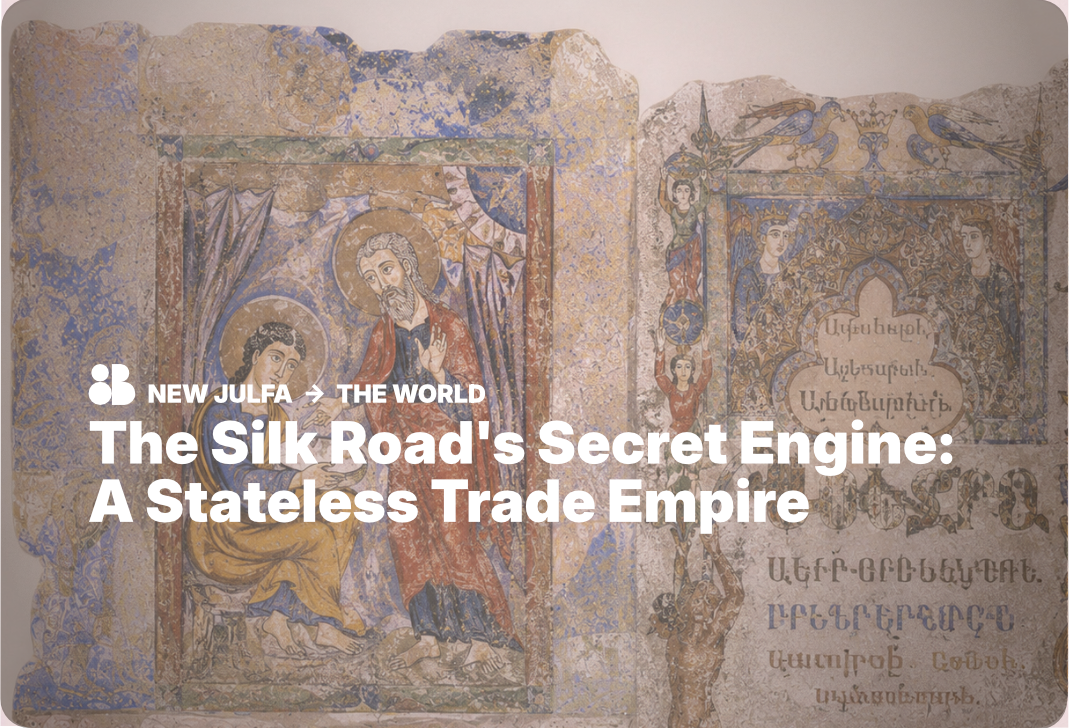
The lesson remains relevant for payment infrastructure today. A neutral connecting layer can create value precisely because it does not require banks, wallets or payment systems to abandon their own networks. Instead, it allows them to interoperate.
The strongest infrastructure does not necessarily replace local systems. It enables value to move between them.
From merchant correspondence to payment interoperability
There is no direct equivalence between a 17th-century merchant network and a modern payment platform. The technologies, regulatory environments and settlement mechanisms are fundamentally different.
But the underlying architecture has recognisable elements:
- trusted participants with clearly defined roles;
- local knowledge distributed across several markets;
- shared commercial standards;
- mechanisms for accountability;
- the ability to operate across political and institutional boundaries;
- access to infrastructure owned by other parties.
Modern national QR and account-to-account systems are creating new domestic payment ecosystems. Within their home markets, they can provide familiar user experiences, direct access to bank accounts and lower dependence on international card networks.
Their cross-border value emerges when these domestic systems become interoperable.
A traveller should be able to use a familiar banking or wallet application abroad. A merchant should be able to accept that payment without integrating separately with every foreign system. Banks and payment providers should be able to connect to new markets without rebuilding the entire local acceptance and settlement chain.
This requires more than a QR code. It requires identity, compliance, liquidity, foreign exchange, technical standards and trusted local participation.
The corridor comes before the product
The New Julfan merchants did not begin with a universal financial product. They began with relationships between specific communities and markets.
Over time, those relationships supported trade, credit, information exchange and the movement of value across a much wider geography.
Modern payment corridors often evolve in the same direction. Migration and remittance flows establish beneficiary networks, liquidity and familiarity between two markets. As the corridor matures, the same infrastructure can begin supporting contractors, creators, merchants, suppliers and exporters.
The infrastructure remains, while the payment changes category.
This is why the future of cross-border payments will not be defined by a single global payment method. It will depend on interoperability between local systems and on infrastructure capable of connecting them without removing what makes each market local.
The merchants of New Julfa did not own the empires, ports or fleets through which they operated. They built value by connecting them.
Four centuries later, that remains a useful model for cross-border payment infrastructure.
You may be interested in: