Uzbekistan–South Korea: Two Ends of the Silk Road That Found Each Other
From Goguryeo envoys in 7th-century Samarkand to Korean investment and a $458M remittance corridor, Uzbekistan and South Korea are rediscovering two ends of the Silk Road.
Millennia ago, trade routes connected Samarkand to distant shores. Today, the bond between Uzbekistan and South Korea is being reborn in technology, capital, culture and memory.
Behind the differences in religion, language and geography lies a deep structural similarity. Both Uzbekistan and South Korea carry a strong sense of historical continuity. Both understand trust as something built through relationships, memory and shared experience. And both see themselves not as peripheral markets, but as civilisations with their own centres of gravity.
Their connection is often described as a modern partnership. Its roots, however, reach back approximately 1,400 years.
Koreans in 7th-century Samarkand
In the 15th century, envoys and merchants from China, India, Persia and across Eurasia converged on Timurid Samarkand. The city pulsed at the heart of Eurasian civilisation.
This identity was expressed not only through trade and diplomacy, but through knowledge. Ulugh Beg's Zij-i Sultani, completed in 1437, catalogued 1,018 stars across 48 constellations. Its calculation of the sidereal year had a margin of error of approximately 58 seconds and remained among the most accurate of its kind until the work of Tycho Brahe in the 16th century.
For Uzbeks, this is not simply a museum fact. It supports a living idea: we are not the periphery; we are the centre.
But the earliest evidence connecting this region to Korea predates the Timurid era by centuries.
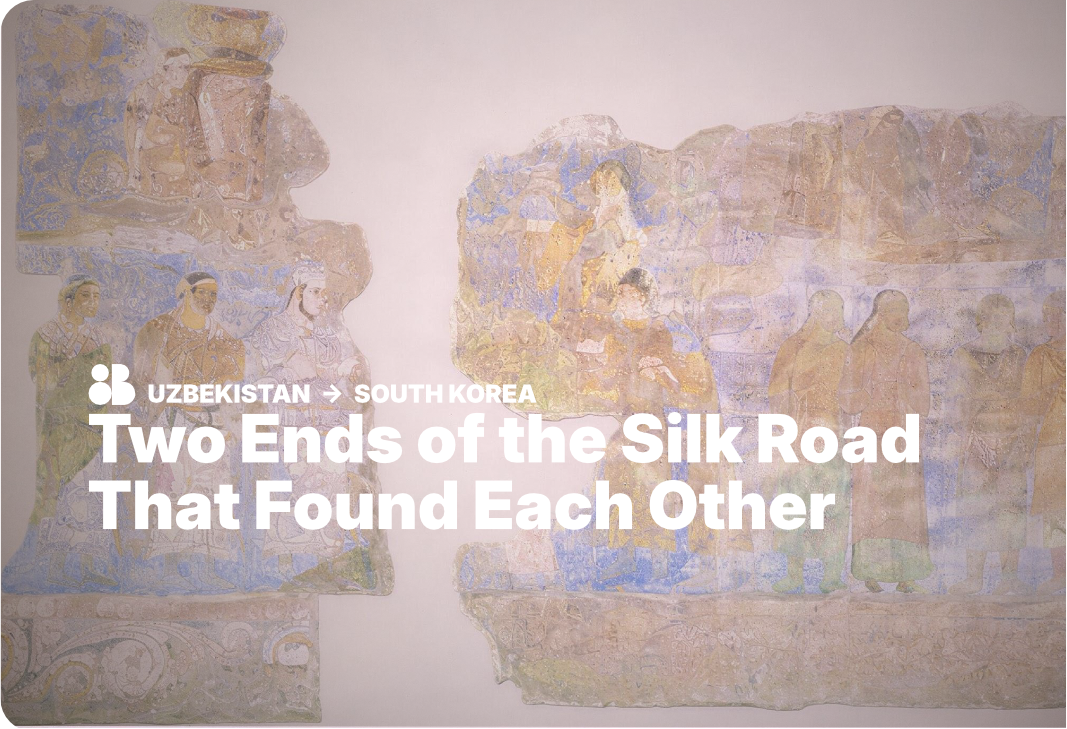
The Afrasiab murals in Samarkand's Hall of the Ambassadors, painted in the mid-7th century, depict a ceremonial procession converging on the Sogdian ruler Varkhuman. Among the figures are delegations widely interpreted by scholars as coming from China, Tibet, Central Asian states and the Korean kingdom of Goguryeo.
The murals are pigment on plaster, excavated in the 1960s - archaeological evidence rather than legend. They are considered the oldest known visual evidence of a Korean presence in Central Asia.
Some 1,400 years before Samsung, Hyundai or the modern “K-Silk Road”, the two ends of the Silk Road were already face to face on the walls of Samarkand.
Where two peoples are more alike than they seem
Uzbekistan and South Korea developed in very different cultural and religious environments, yet their systems of trust contain recognisable parallels.
Uzbeks see themselves as heirs to the Timurid world, with Samarkand as one of history's great centres. Koreans preserved a continuous civilisation despite living alongside much larger neighbours. Neither people readily thinks of itself as belonging to a “small country”.
In Uzbekistan, family, mahalla, personal introductions and the shared table remain important parts of trust-building. A stranger can become “one of us”, but the relationship takes time. In Korea, Confucian values continue to shape language, hierarchy, business etiquette and the meaning of long-term commitment.
The difference in pace is real. Korean business culture is associated with ppalli-ppalli - “quickly, quickly” - where punctuality communicates respect and each day is scheduled precisely. Uzbek business culture can be more adaptive and relationship-driven.
Yet both cultures understand that serious partnerships extend beyond a single transaction. Personal credibility, loyalty and a willingness to invest in the relationship can matter as much as the contract itself.
This shared architecture of trust helps explain why deep negotiation between the two countries is possible, even when their working rhythms differ.
What each country brings to the partnership
Uzbekistan offers geography, resources and demographic momentum. With more than 37.5 million people, it is the most populous country in Central Asia. It sits at the heart of the region and combines a young, urbanising workforce with reserves of uranium, gold, copper, cotton and gas.
South Korea offers technology, R&D, capital, global brands and manufacturing discipline. Korean investment in Uzbekistan has exceeded $7.5 billion since diplomatic relations were established in 1992, according to the President of Uzbekistan.
Together, the two countries are building transport infrastructure, industrial capacity, electronics and food-processing operations, digital systems and what both increasingly describe as an innovation Silk Road.
Korean capital is visible across several sectors:
- Infrastructure, including the Hyundai Rotem high-speed rail service between Tashkent and Khiva, Navoi Airport development and broader transport corridors.
- Electronics and manufacturing, through brands and partnerships involving Samsung, LG and other Korean companies.
- Retail, hospitality and FMCG, including the presence of Lotte Group.
- Pharmaceuticals and chemicals, where joint ventures position Uzbekistan as a manufacturing base for the wider CIS.
- Agriculture and food processing, including greenhouse technology, modernisation and export-grade safety standards.
- IT and digital infrastructure, from e-government projects to smart-city, customs and logistics initiatives.
The partnership is designed to become self-reinforcing. Korean capital and technology help Uzbekistan expand local production. Uzbekistan then strengthens its export capacity and earns foreign currency through sales to the CIS, Europe and China. Rising incomes create more demand for electronics, mobility and other high-technology products. Korea, in turn, gains a more stable and increasingly self-funded market.
It is not simply a cycle of dependence. It is a potential flywheel of shared growth.
The partnership in action
One of the clearest symbols of the relationship is the Hyundai Rotem high-speed rail project.
Following the $195 million supply agreement signed in June 2024, Uzbekistan launched Hyundai Rotem high-speed service on the Tashkent-Khiva route. The railway connects the capital to one of the Silk Road's most recognisable cities and demonstrates how historical geography is being converted into modern infrastructure.
Samsung, LG and Lotte have expanded their presence across electronics, retail, hospitality and food-related industries. Korean companies and institutions have also contributed to the development of Navoi Airport, named after the 15th-century poet and statesman Alisher Navoi.
Here, infrastructure and poetry become part of the same national symbol: the modern corridor is built through places that already carry centuries of cultural meaning.
A $458 million remittance corridor
The relationship is also becoming increasingly visible in financial flows.
Approximately 100,000 Uzbeks were working in South Korea in 2024, according to Uzbekistan's Migration Service. They are part of a corridor that links migration, education, business and family life.
During January-October 2024, Uzbekistan received $458 million in remittances from South Korea, an increase of 71% year on year, according to the Central Bank of Uzbekistan.
South Korea has therefore become one of Uzbekistan's largest non-CIS sources of remittances. The scale of the flow shows that the corridor is no longer only cultural or diplomatic. It already has substantial financial weight.
But scale does not eliminate friction.
The World Bank's remittance-cost methodology includes both the transaction fee and the margin applied to currency conversion. Using an indicative cost range of 5-7%, the $458 million flow implies potential transaction and FX costs of approximately $23-32 million.
This is an illustrative estimate rather than a measured corridor-specific loss. It nevertheless shows how even moderate friction becomes economically significant once a corridor reaches sufficient scale.
From friction to infrastructure
The opportunity is not to remove regulation. It is to make compliant transfers more direct, transparent and competitive.
Korea's Foreign Exchange Transaction Act maintains reporting and monitoring requirements for cross-border transfers. At the same time, the country's reform agenda points towards a more permissive “negative-list” framework in which more transactions can proceed unless they are explicitly restricted.
Pricing is also more complex than a visible transfer fee. Limited direct KRW-UZS liquidity can introduce intermediary currencies, additional spreads and less transparent exchange-rate pricing.
In Uzbekistan, the Central Bank's FX-market development agenda focuses on deeper interbank trading, stronger price discovery, transparency and liquidity. Greater market depth and more direct settlement options could gradually reduce conversion friction in bilateral flows.
The corridor already has volume, trust and a strong human foundation. The next stage is infrastructure capable of converting these advantages into lower-cost, compliant financial flows.
The living cultural bridge
The approximately 100,000 Uzbeks in South Korea are not only workers. They carry language, food, habits and relationships in both directions.
In Uzbekistan, Korean dramas and K-pop have developed a large young audience. Interest in Korean-language education is growing, Korean cuisine has entered Tashkent's restaurant scene, and Korean beauty brands have built a visible presence in the premium skincare market.
In the other direction, plov and Uzbek tea culture are finding new audiences in Seoul. Uzbek students are becoming more visible at Korean universities, while Uzbek literature is reaching Korean readers. In June 2025, Abdulla Qodiriy's Bygone Days was published in Korean for the first time.
Student exchanges, cultural festivals and Korean support for Uzbek heritage projects continue to deepen the relationship. Beneath these exchanges are shared values: respect for elders, the importance of family meals and a strong sense of collective identity.
Koryo-saram: a universe apart
The least-known and perhaps most poetic layer of the relationship is the Koryo-saram community.
Koryo-saram are the Koreans of the former Soviet Union. In 1937, approximately 172,000 ethnic Koreans were deported by Stalin from the Soviet Far East to Central Asia. They established new lives in Kazakhstan and Uzbekistan, combining Korean identity with the Russian language and Central Asian memory.
Today, approximately 177,000 Koryo-saram live in Uzbekistan, according to South Korea's Ministry of Foreign Affairs. Members of the community are present across business, public life, academia and culture.
Viktor Tsoi, the iconic leader of the Soviet rock band Kino, embodied this layered identity. His father was Koryo-saram, born in Kazakhstan to a family deported in 1937; his mother was Russian. Tsoi grew up in Leningrad, but his music belonged as much to listeners in Tashkent and Alma-Ata as it did to those in Moscow or Leningrad.
The deportation scattered Koreans across Central Asia. In doing so, it inadvertently created a cultural bridge that continues to live through language, family networks, music and memory.
The hidden business advantage
When South Korea partners with Uzbekistan, it is often also activating its own diaspora.
Koryo-saram can operate as cultural translators. Many speak Russian, understand Korean family dynamics and know the social logic of Uzbek mahalla culture. They can translate Korean urgency into Uzbek relationship-building - and patience back into action.
Their family ties often span Uzbekistan, Kazakhstan, South Korea and other CIS markets. As a result, introductions made around a family table can eventually become regional business relationships.
For many Koryo-saram, Korean investment in Uzbekistan can carry meaning beyond a conventional commercial project. It connects their Korean identity with support for the country they call home.
A Korean company entering Uzbekistan is therefore not beginning with an empty map. It may already have access to a human infrastructure built through generations of shared history.
Voices at the crossroads
Literature provides another way to understand the corridor.
Abdulla Qodiriy, regarded as the father of Uzbek prose, wrote the first Uzbek novel, Bygone Days. Published in book form in 1926, it entered Korean in 2025.
Alisher Navoi was a classical Turkic poet and statesman at the Timurid court in Herat. Today, both a city and an international airport hub bear his name - evidence that a poet and a piece of infrastructure can become parts of the same civilisational brand.
Anatoly Kim, born in Kazakhstan to a Koryo-saram father and Russian mother, created prose in which Korean mythology, Sufi philosophy and Russian literary tradition meet in a single language.
Their work shows that cultural corridors do not belong exclusively to one nation. They are often created by people who live between worlds.
More than a partnership
The Uzbekistan-South Korea relationship operates simultaneously on four levels.
It has an economic flywheel: Korean investment supports Uzbek industrial development, export capacity and rising demand.
It has cultural compatibility: both societies understand trust as something built through relationships, family and long-term commitment.
It has approximately 1,400 years of historical depth, from figures interpreted as Goguryeo envoys on the walls of Afrasiab to an Uzbek literary classic appearing in Korean.
And it is a living corridor: approximately 100,000 Uzbeks in South Korea, 177,000 Koryo-saram in Uzbekistan, expanding business networks and hundreds of millions of dollars moving between the two economies.
The Silk Road never disappeared. It simply changed its cargo.
You may be interested in:
Continue Your Research