One Nation, Two States: How the Azerbaijan–Turkey Corridor Connects Culture, Energy and Payments
Azerbaijan and Turkey are two sovereign states connected by a shared cultural genome stretching from the Caspian Sea to the Bosphorus. Their relationship is often expressed through the formula “One nation, two states,” attributed to former Azerbaijani President Heydar Aliyev. But the connection is more than political rhetoric. It rests on mutually intelligible languages, shared epics, closely related social traditions and an increasingly integrated economic corridor built around energy, trade, investment and financial flows. This combination makes Azerbaijan and Turkey a particularly revealing example of how cultural trust can evolve into strategic and commercial infrastructure.
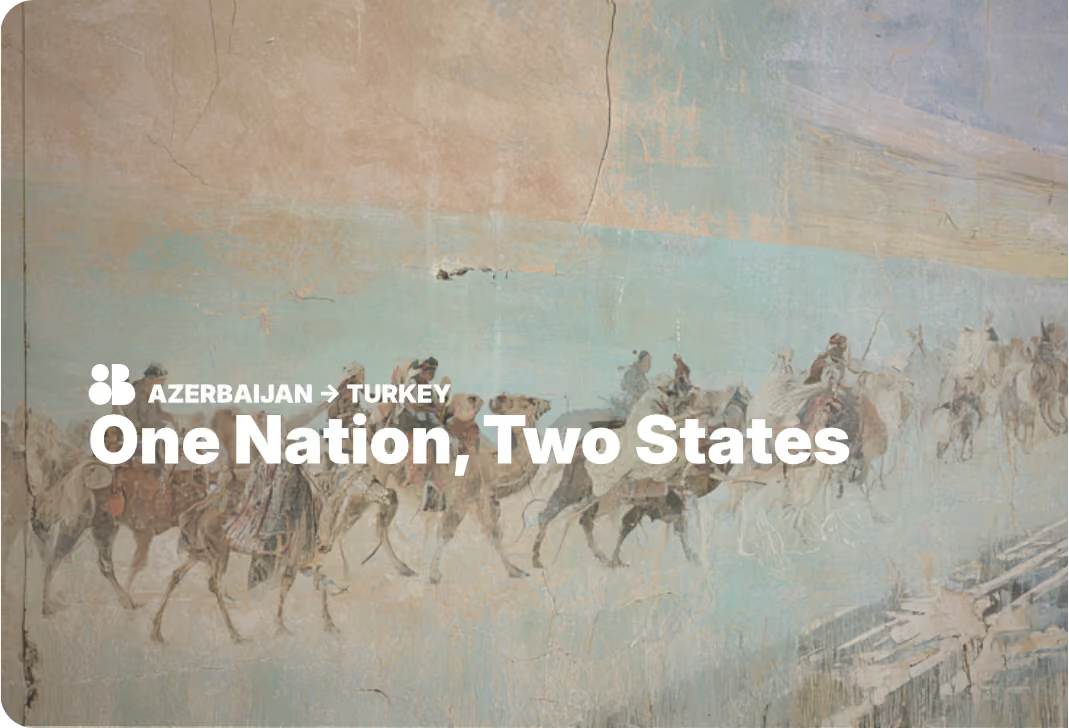
One historical memory across two states
Modern Azerbaijanis and Anatolian Turks trace much of their linguistic and cultural heritage to the Oghuz Turkic tribes that migrated westward during the 11th century.
Their histories later unfolded in different political and imperial settings. Anatolia became the centre of the Ottoman Empire, while Azerbaijan developed through Persianate, Caucasian, Russian imperial and Soviet influences. Yet many elements of their common heritage remained interconnected.
Baku’s transformation into one of the world’s leading oil-producing centres in the late 19th century added another layer to this history. International investment, industrialisation and energy exports gave Azerbaijan an economic role that would eventually become central to its partnership with Turkey.
The result is not cultural uniformity. Azerbaijan and Turkey developed distinct political systems, national identities and economic priorities. But beneath these differences lies a shared frame of reference that continues to influence how the two countries understand one another.
The Book of Dede Qorqud: a shared cultural foundation
One of the clearest expressions of this common heritage is the Kitabi Dede Qorqud, or the Book of Dede Qorqud.
The epic cycle celebrates courage, family honour, loyalty and faith. Its stories reflect the transition from pre-Islamic traditions to the Islamic cultural world shared by the ancestors of both peoples. Two principal manuscripts survive today: the Dresden Manuscript and the Vatican Manuscript.
The epic also preserves linguistic features shared by Azerbaijani and Anatolian Turkish before the two languages fully diverged. Today, both countries recognise it as part of their literary heritage.
In 2018, the heritage of Dede Qorqud, Korkyt Ata and Dede Korkut was inscribed on UNESCO’s Representative List of the Intangible Cultural Heritage of Humanity through a multinational nomination by Azerbaijan, Kazakhstan and Turkey.
Other shared Oghuz traditions include the Oghuzname narratives centred on Oghuz Khan, the legendary ancestor of the Oghuz peoples, and Koroghlu, a heroic cycle preserved in closely related forms in Azerbaijani and Turkish culture.
These epics matter because they provide more than a common historical reference. They create a shared language of loyalty, honour, obligation and belonging — concepts that continue to influence political and commercial relationships.
Related languages, distinct national identities
An Azerbaijani and a Turk can usually understand one another without an interpreter. Differences remain in vocabulary, pronunciation, grammar and word order, but both languages belong to the Oghuz branch of the Turkic language family.
Even the names used for legendary figures demonstrate this continuity. Azerbaijani “Oğuz Xaqanı” and Turkish “Oğuz Kağan” refer to the same ruler, with differences that are primarily orthographic and phonetic rather than semantic.
At the same time, cultural affinity should not be confused with political unity. Azerbaijan and Turkey remain pragmatic sovereign states. They draw on their shared identity when it supports strategic and economic cooperation, while continuing to pursue their own national interests.
The formula “One nation, two states” captures this balance. Public discourse in both countries commonly frames the relationship as fraternal rather than merely friendly, but the partnership is maintained through institutions, commercial interests and repeated cooperation — not sentiment alone.
Different business environments, a familiar trust code
Azerbaijan’s business culture reflects several overlapping influences: Oghuz Turkic heritage, Persianate and Shia traditions, Caucasian social structures, the Baku oil economy and decades of Soviet industrial development.
Turkey’s commercial culture combines Oghuz and Anatolian traditions with the institutional legacy of the Ottoman state, a strong manufacturing base and a more diversified private sector.
These histories have produced different business environments, but the foundations of trust remain similar.
In both markets, personal introductions and reputation carry significant weight. Business conversations may begin with family, health, the city or mutual acquaintances before moving into commercial detail. Hospitality is not separate from the negotiation process; it helps establish the personal confidence on which a durable agreement can be built.
Relationships may initially take precedence over rigid timelines, especially during the early stages of a partnership. Turkey’s commercial environment may be more deadline-conscious, but personal credibility and repeated interaction still matter.
This does not reduce the importance of contracts, compliance or due diligence. Formal agreements remain essential. The practical point is that documentation works best when it is supported by personal trust rather than expected to replace it.
Hospitality as an economic signal
Hospitality in Azerbaijan and Turkey communicates both respect and aspiration.
Traditionally, the best room, finest dishes and most valued possessions are reserved for guests. The setting presents the household’s ideal self and signals how seriously the relationship is taken.
A similar instinct can appear in business. Partners may begin by presenting their strongest capabilities, most important relationships and highest ambitions. This presentation indicates future potential, but lasting credibility depends on consistent delivery.
For an international partner, the practical sequence is straightforward:
- recognise the presentation as a signal of ambition;
- build rapport through personal attention and hospitality;
- evaluate credibility through references, consistency and execution.
Trust develops gradually, but once established, it can reduce distance in future negotiations and support long-term commercial relationships.
What Azerbaijan and Turkey bring to the corridor
The bilateral relationship is sustained not only by cultural proximity but also by complementary economic strengths.
Azerbaijan contributes Caspian oil and gas resources, strategic transit geography, sovereign investment capacity and access to markets across the Caucasus, Central Asia, Russia and Iran. Turkey contributes manufacturing, defence capabilities, access to European trade networks and a major financial and commercial centre in Istanbul.
Together, the two countries have built infrastructure that connects the Caspian region with the Mediterranean and European markets.
The Baku–Tbilisi–Ceyhan pipeline carries Azerbaijani oil to Turkey’s Mediterranean coast. The Southern Gas Corridor connects the Shah Deniz field in the Caspian Sea with European markets through the South Caucasus Pipeline, the Trans-Anatolian Natural Gas Pipeline and the Trans Adriatic Pipeline.
TANAP crosses approximately 1,850 kilometres of Turkey and has an initial capacity of 16 billion cubic metres of gas per year. TAP extends the corridor through Greece and Albania to Italy, enabling commercial deliveries of Azerbaijani gas to Europe since 2020.
This infrastructure supports European energy diversification while reinforcing the economic interdependence of Azerbaijan and Turkey.
From energy cooperation to allied relations
Energy is only one component of the partnership.
Turkey provided diplomatic support to Azerbaijan during the First Karabakh War in the early 1990s. During the 2020 Second Karabakh War, Turkish political and defence support accompanied Azerbaijan’s military campaign, while Bayraktar TB2 drones became one of its most visible technological components.
The Shusha Declaration, signed on 15 June 2021, established allied relations and strengthened bilateral commitments in security, defence and mutual assistance.
The countries also cooperate through the Organization of Turkic States, which brings together Azerbaijan, Turkey, Kazakhstan, Kyrgyzstan and Uzbekistan, alongside observer members.
Proposed regional transport links could further connect mainland Azerbaijan with Nakhchivan and strengthen east–west trade. Their final legal and political framework remains under negotiation, but the underlying objective is clear: to turn geographic and cultural proximity into a more integrated logistics and commercial network.
Trade, investment and financial flows
The Azerbaijan–Turkey financial relationship is substantial but asymmetric.
Bilateral trade turnover reached approximately $6.1 billion in 2024. Turkey is an important supplier of goods, services, construction and industrial expertise to Azerbaijan, while Azerbaijan’s presence in Turkey is driven by large-scale energy investment.
SOCAR’s total investment in Turkey has reached approximately $18 billion. Its major assets include the STAR Refinery in Izmir and the Petkim petrochemical complex. This investment has made SOCAR one of Turkey’s largest foreign direct investors.
The corridor also carries growing personal financial flows. During the first half of 2025, money transfers from Turkey to Azerbaijan reached approximately $140 million, while flows from Azerbaijan to Turkey totalled around $104 million.
These flows reflect travel, education, family connections, employment and small-scale commercial activity. Together with trade and investment, they create the financial foundation for a broader cross-border payment corridor.
Where friction remains
Cultural proximity and strong economic relations do not automatically create frictionless payments.
The Azerbaijani manat is managed closely against the US dollar, while the Turkish lira is free-floating and considerably more volatile. Transfers between the two currencies may therefore be routed through a major settlement currency, typically the US dollar or euro, adding conversion costs and additional operational steps.
Exchange-rate volatility also creates risk for Turkish businesses working with Azerbaijani counterparties. Corporate payments commonly move through the international banking system, while individuals rely on banks, money-transfer systems and remittance applications.
The corridor is therefore economically active but financially fragmented. Trade, investment and personal transfers are already present; the remaining challenge is to connect them through faster, more transparent and more interoperable payment infrastructure.
From cultural corridor to payment corridor
The Azerbaijan–Turkey relationship demonstrates how a commercial corridor develops.
It begins with shared memory and cultural familiarity. These create trust and repeated human interaction. Trade and migration add recurring financial flows. Energy infrastructure then links the two markets at strategic scale. Banks, payment providers and settlement systems emerge around those flows.
The corridor does not begin as a payment product. Payments arrive after the relationship has already created a reason for money to move.
This is why established cultural and economic corridors can become important foundations for new financial infrastructure. Once identity, trust, liquidity and beneficiary reach are present, the same routes can support not only family transfers but also contractors, merchants, suppliers, exporters and digital businesses.
The infrastructure remains. The payment changes category.
The corridor is still evolving
From the Oghuz migrations and the Book of Dede Qorqud to Baku oil, the Southern Gas Corridor and the Shusha Declaration, the Azerbaijan–Turkey relationship has repeatedly translated shared identity into practical cooperation.
Today, that cooperation encompasses energy, manufacturing, defence, logistics, investment, remittances and trade. The next stage is likely to depend on how effectively banks, fintechs and payment providers can connect these economic flows.
The Oghuz corridor never disappeared. It changed its operating language — from epic verse to pipeline contracts, investment agreements and cross-border payment infrastructure.
You may be interested in:
Continue Your Research