From Factory Floors to Cross-Border Payments: How QR Codes Became a Global Payment Interface
The QR code was created to solve a problem on an automotive production line. More than 30 years later, the same technology is used to open restaurant menus, validate tickets, connect devices and initiate payments directly from bank accounts.
.png)
Its history is not a story of one sudden breakthrough. It is a sequence of developments: greater data capacity in 1994, international standardisation in 2000, consumer adoption through mobile phones in the early 2000s, easier camera-based scanning in the 2010s, contactless use during the pandemic and, finally, integration with real-time payment systems.
Today, the next chapter is interoperability: enabling a familiar QR payment experience to work not only within one country, but across borders.
1994: a manufacturing problem leads to the QR code
In the early 1990s, conventional barcodes were widely used in manufacturing and logistics. But they had an important limitation: a standard one-dimensional barcode could hold only around 20 alphanumeric characters.
Production teams compensated by placing several barcodes on the same item or box. According to DENSO WAVE’s account of the development process, workers sometimes had to scan approximately 1,000 barcodes in a single day. A system designed to improve efficiency was creating a new operational burden.
Masahiro Hara, who worked on barcode scanners at DENSO, initially explored ways to make the scanners faster. He eventually concluded that the limitation was not only the scanner. The code itself needed to change.
Hara and one other team member began developing a compact code that could contain more information, including Japanese Kanji and Kana characters, while being read at high speed.
The key was moving from one dimension to two.
A conventional barcode stores data in one direction. A two-dimensional code can use both horizontal and vertical space, dramatically increasing its capacity. The team also designed three distinctive square position markers, allowing a scanner to find and read the code quickly from any orientation.
After approximately a year and a half of development, DENSO WAVE released the QR code in 1994. The letters stood for “Quick Response”, reflecting the original objective: high-speed reading.
The automotive industry adopted it for production, shipping and electronic Kanban processes. Its ability to hold more information also made it useful for product traceability in industries such as food and pharmaceuticals.
1997–2000: standardisation takes QR beyond one company
Technical performance alone does not turn a technology into a universal interface. Other companies must be able to implement it consistently.
DENSO WAVE held patent rights related to the QR code but chose not to exercise them for standardised QR codes. It also made the specifications publicly available. This decision helped the code spread beyond its original industrial environment.
The standardisation timeline moved quickly:
- 1997: the QR code was approved as an AIM standard for the automatic identification industry.
- 1999: it became a Japanese Industrial Standard and was included in standard transaction forms used by the Japan Automobile Manufacturers Association.
- 2000: ISO published the first international QR code standard, ISO/IEC 18004:2000.
The original 2000 edition has since been revised. The current published edition is ISO/IEC 18004:2024. The continuing revisions reflect the QR code’s evolution while preserving a common technical foundation.
Standardisation gave manufacturers, software developers and device makers a shared specification. The QR code was no longer simply a solution for one production ecosystem. It could become a global technology.
2002: mobile phones bring QR codes to consumers
The consumer history of QR codes began earlier than many people assume.
According to DENSO WAVE, QR code use became widespread among the Japanese public in 2002, helped by mobile phones equipped with QR-reading functionality. People could scan a code to open a website or retrieve a coupon instead of typing a long address.
This was an important change in the role of the technology. In a factory, the QR code connected a physical component to production data. On a mobile phone, it connected a physical object, advertisement or ticket to a digital action.
During the 2000s and early 2010s, QR codes appeared in marketing campaigns, electronic tickets, travel, product information and event access. Adoption varied by market, and many smartphones still required a dedicated scanning application.
2017: native camera recognition removes friction
It is sometimes claimed that smartphone cameras began reading QR codes natively in 2012. That date is misleading.
Mobile phones with built-in QR-reading features existed in Japan as early as 2002, while third-party scanner applications later brought the function to many smartphones. Native support in the standard camera application arrived at different times across devices and operating systems.
One clearly documented milestone came in 2017, when Apple added automatic QR code recognition to the Camera and Safari applications in iOS 11. Users could point the standard camera at a QR code and open the associated action without first downloading a separate scanner.
Reducing this small piece of friction made an important difference. A QR code could now serve as a broadly accessible interface for websites, applications, tickets, contact details and Wi-Fi configuration.
2020: the pandemic accelerates contactless use
The COVID-19 pandemic did not create QR code adoption, but it accelerated it.
Businesses and public institutions needed ways to reduce shared physical touchpoints. QR codes offered an inexpensive and widely accessible way to connect a printed surface with a digital service.
They became common in:
- contactless restaurant menus;
- venue and travel check-ins;
- digital forms and health information;
- ticket validation;
- product information; and
- payment journeys.
This period reinforced the QR code’s role as a bridge between physical and digital environments. A person could scan a printed code with a device already in their pocket and continue the interaction on a website or in an application.
However, a QR code should not be described as an encrypted channel. The code is a data carrier: it may contain information directly or point an application to another resource. Security, authentication and encryption depend on the application, network and service operating behind it.
That distinction becomes especially important when QR codes are used for payments.
2016 onward: account-to-account systems turn QR into a payment interface
QR codes became much more significant in payments when they were combined with fast account-to-account payment systems.
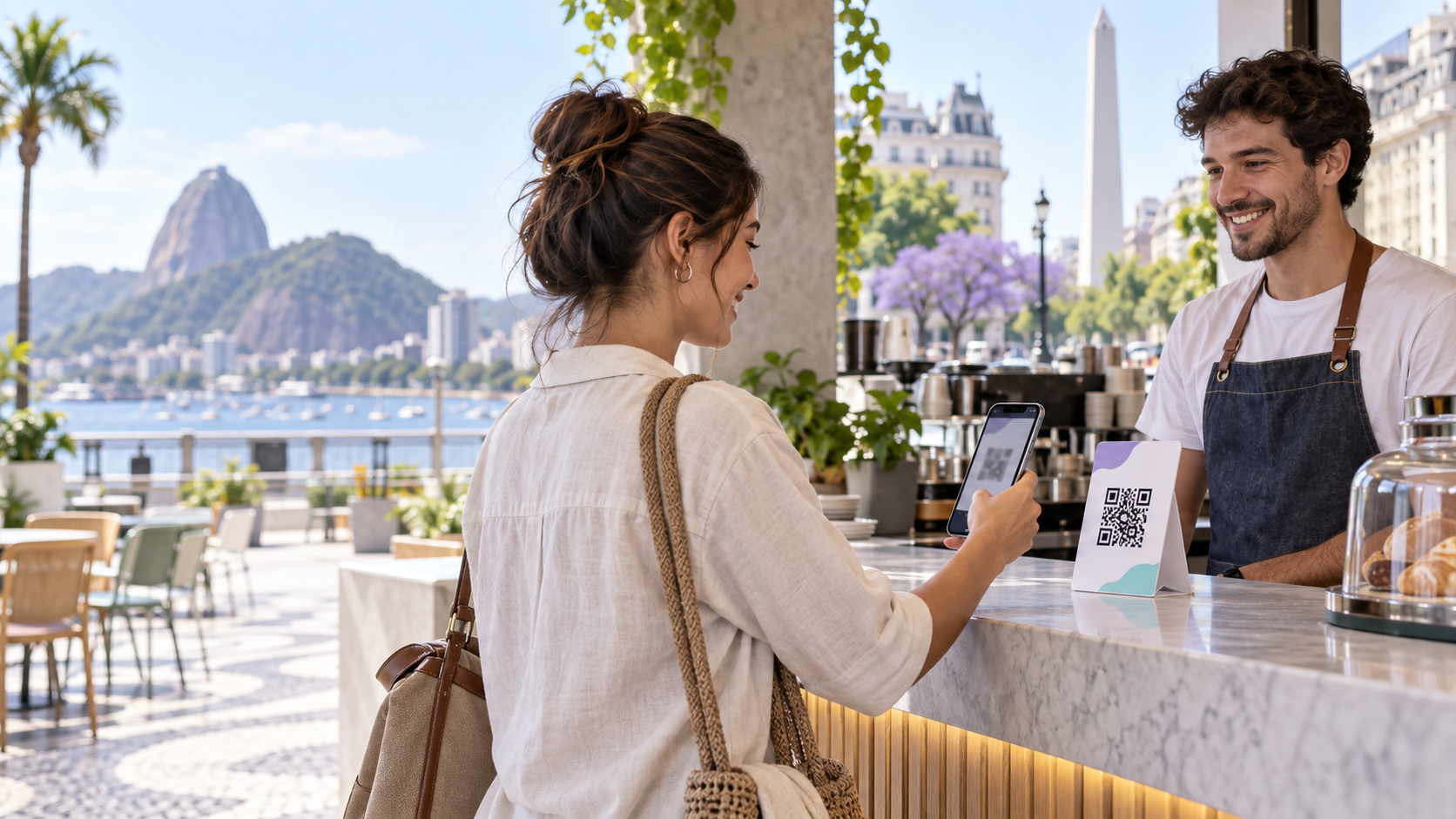
India’s Unified Payments Interface, launched in 2016, supports merchant payments using static and dynamic QR codes. Brazil launched Pix in 2020; transactions can be initiated using a Pix key or a QR code associated with the beneficiary’s account.
Other markets have developed their own national or regional approaches to QR and instant account-to-account payments. Some are led by central banks, while others are operated by regulated payment organisations or private-sector participants.
In these systems, the QR code is the visible interface, not the complete payment method.
A typical payment journey may look simple:
- The customer scans a merchant’s static or dynamic QR code.
- A banking or payment application reads the merchant and transaction information.
- The customer reviews and authorises the payment.
- The underlying payment infrastructure processes the account-to-account transfer.
- The customer and merchant receive confirmation.
The simplicity of the scan hides the work performed by the payment system: authentication, processing, routing, settlement, transaction controls and reporting.
The 2020s: the focus shifts from adoption to interoperability
National QR payment systems have shown that consumers can use a simple scan to pay directly from a bank account. The next challenge is making these experiences interoperable.
Most domestic systems were designed around one country’s currency, regulation, payment participants and settlement infrastructure. Cross-border QR payments must connect different environments without making the customer navigate that complexity.
This requires more than technical QR-code compatibility. It can involve:
- recognition of different QR formats and payment rules;
- connections between wallets, banks, acquirers and payment schemes;
- foreign exchange and clear presentation of the final amount;
- cross-border clearing and settlement;
- compliance with the requirements of each market;
- fraud prevention and transaction monitoring;
- reconciliation and reporting; and
- customer and merchant support.
The Bank for International Settlements identifies interoperability by design, broader access and links between fast-payment systems as important foundations for better cross-border retail payments. The World Bank similarly notes that fast-payment systems can support domestic and cross-border use cases as they evolve.
The goal is not to make customers understand the infrastructure. It is to make an international transaction feel as intuitive as the domestic payment experience they already know.
Is the QR code itself secure?
The familiar black-and-white pattern can create the impression that information inside a QR code is automatically protected. It is not.
A standard QR code encodes data in a machine-readable form; it does not automatically encrypt that data or verify that the destination is trustworthy. As with a printed web address, a malicious party may attempt to replace a legitimate code or redirect a user to a fraudulent destination.
In a well-designed payment experience, protection comes from the wider system. Relevant controls can include secure application communication, merchant validation, transaction authentication, confirmation of the recipient and amount, fraud monitoring and clear dispute or support processes.
The safest principle for users is simple: scan through a trusted banking or payment application, verify the merchant and amount displayed, and never authorise a transaction that does not match the intended purchase.
What comes after the QR code?
The QR code has survived repeated changes in devices, networks and consumer behaviour because it performs one function exceptionally well: it makes a digital action accessible from a physical object.
Its evolution can be summarised in six stages:
- 1994: a high-capacity, high-speed code for industrial operations.
- 1997–2000: national and international standardisation.
- 2002: widespread consumer use through QR-enabled mobile phones in Japan.
- 2017: native recognition in major smartphone camera software reduces scanning friction.
- 2020: the pandemic accelerates contactless use while systems such as Pix expand QR-based A2A payments.
- The 2020s: payment providers and public authorities increasingly focus on interoperability, including links between fast-payment systems across borders.
The QR code is no longer an innovation by itself. Its importance comes from what organisations can connect behind a scan.
For payments, that means moving from a visual code to an end-to-end service: one that can identify the merchant, authenticate the customer, process the transaction, manage risk and complete settlement.
The code began by helping factories process information more efficiently. Its next chapter may be helping payment systems do the same across borders.
You may be interested in: